
Previous Developments
In 2007, Tanzania achieved a nearly universal access to primary education. Since then, however, the number of children of primary school age has declined. An estimated 2 million children between the ages of 7 and 13 are out of school. Almost 70 percent of children ages 14 to 17 are not enrolled in secondary school, while only 3.2 percent are enrolled for the final two years of school.
Justice and quality are major challenges. Primary school-age children from the poorest families are three times less likely to attend school than children from the wealthiest households. While it is estimated that 7.9 percent of Tanzanians live with a disability, fewer than 1 percent of children in pre-school, primary and secondary school have a disability.
Access to pre-school education is very limited and the poor quality of education dampens children’s prospects for a productive future. The ratio of students to qualified preschool teachers is 131:1. This ratio is 169:1 in public preschool compared to 24:1 in private schools. Most children, particularly in rural areas, enter primary school ill-prepared due to lack of access to early stimulation, poor nutrition and poor quality preschool education.
School children often fail to achieve basic learning outcomes such as literacy, arithmetic and life skills that determine future achievement. 2014 primary school leaving exam results in mainland Tanzania showed that only 8 percent of second grade students could read correctly, only 8 percent could add or subtract, and less than 0.1 percent had high levels of life skills (academic grade, confidence, Troubleshooting).
Girls, the poorest children, children with disabilities and children living in underserved communities are the most vulnerable to dropping out or never going to school. Early marriage and pregnancy keep girls out of school. Teenage pregnancy led to almost 3,700 girls dropping out of primary and secondary education in 2016. More than a third of all girls are married by the age of 18, but girls from poor families are twice as likely to be married early as girls from wealthier families.
Source: UNICEF
Weaknesses of public schools
Teachers. One of the biggest problems in the Tanzanian education system is the overwhelming lack of qualified teachers. It is understandable that their number could not increase to the same extent as the number of students. As a result, assistant teachers and teachers with a very basic education are still being hired by teacher colleges. This training is available to any 17-year-old secondary school graduate (simple degree only). As many school leaders have confirmed to us, this training is not enough to achieve better results using new teaching methods. Another measure is the recruitment of additional teachers from abroad, primarily from Kenya. However, only private schools are usually able to do this.
The impact of AIDS illness and death also needs to be addressed at this point, which also contributes to the distress among teachers.
Teacher salaries. Compared to many other professions, teachers in Tanzania are significantly underpaid. Sometimes, and especially in rural areas, they are not paid at all or late for several months. This has a direct impact on the motivation of all teachers, whose presence in schools is noticeably low. Due to the teachers having second and third jobs, but also simply due to demotivation and resignation, a considerable part of the teaching is simply canceled or distributed to the remaining teachers.
These circumstances are much less pronounced in private schools, where teachers are generally paid more.
Pedagogical requirement. In many conversations we have heard reports that the inadequate teacher training and the lack of will to rethink mean that outdated teaching methods are still being used, which do not lead to the desired results.
Due to the financial endowment of private schools and the employment of more qualified teachers, this problem is much less pronounced here than in state schools.
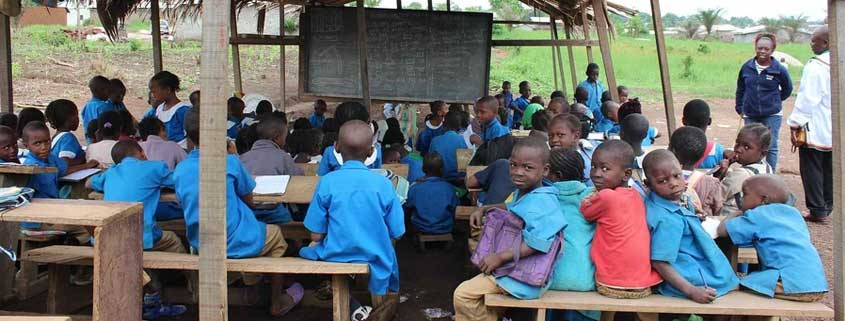
Class sizes. According to a 2012 study, the average class size in Tanzania is 46 children. The number varies significantly between schools in urban and those in rural regions. Even if we consider this number to be far too high by our German standards, we got the impression that there is a great deal of variation here and that state schools in rural areas in particular have class sizes of well over 60 children.
The situation in private schools is less extreme. However, there is a risk here that, from an economic point of view, the class sizes will be too large.
Teaching material & furniture. In 2012, 14 students shared a book in Dar es Salaam. In rural Kigoma there were 41 children. Computers or chemistry laboratories are the exception in state schools and are financed almost exclusively by donations.
School-building. At the same time as the school fees were abolished, the state had tens of thousands of schools built. Every community today has at least one school. These are the basis for running a school and set a clear signal for reform for the population. However, if the necessary means to maintain the objects are missing, they also stand for standstill and decay. After a decade we now see school buildings without windows and doors, with leaking roofs and catastrophic sanitary facilities.
School routes and meals: two reasons for sometimes considerable lack of concentration. The distances to school in rural areas can be more than 6 km. Children who walk to school at 5 a.m. with nothing but a hot cup of tea must start their school day exhausted and hungry.
Burden on parents. The extent to which the abolition of school fees has relieved parents is a subject of critical debate. Parents are still, and perhaps more than ever, burdened with incidental expenses for school supplies, uniforms, exams, lunch, transportation, excursions, medical exams and much more.
CONCLUSION. Tanzania’s society still has a long way to go to optimize the education system in such a way that the next generations are qualified and motivated enough to master the upcoming challenges and advance their country. Until then, only a small part of the population will be able to avoid the problems of state schools and send their children to private schools. But it is precisely comprehensive education that leads to general prosperity and not just that of the elite.
We asked ourselves where Schulbank’s support could be useful without weakening the individual responsibility of society and the government. We have been told several times that supporting state schools tends to result in the authorities withdrawing even more from their responsibilities. Furthermore, we got to know a country with a growth in gross domestic product of 7.0 percent, which is aware of these problems and is able to solve them independently.
Our support goes to those in society who don’t have the slightest chance of a qualified education, orphans and children from poor families. From our point of view, there is currently only one way to obtain the required level of education: through private schools and a few state schools. Through our scholarship program, we can send our support directly to the children, without going through third parties, building schools, purchasing school materials, training teachers, etc. We leave the solution of the problems in the hands of a society that has a sense of responsibility wants to show and does so. In doing so, we refrain from teaching and imposing Western views and practices, and support existing schools and their teaching methods, which should serve as a guide for state schools.
Current facts and figures about the education system

In order to provide the most up-to-date information possible, we refer you to the data collected by Unesco
Private schools - curse and blessing for developing countries
In Africa, the number of private schools for disadvantaged sections of the population is growing. Even the poorest families are willing to pay for their children’s education, as state schools often do not meet the requirements.
In Africa, government schools are failing to educate their students. Experts report that Tanzania public schools lack tens of thousands of teachers and that the knowledge of existing teachers is so low that half would fail a test for eighth grade students. Between 30 and 50% of teachers do not even show up for class. Classes in government schools are overcrowded, some children have to kneel on the floor because there are no benches. As a result, only part of the curriculum is taught and every third student has to repeat the class. The absence of teachers is often due to economic reasons, as they are not able to support their families with their salaries.
Many poor parents in Tanzania are turning to new private schools for better education. These schools are run by churches, NGOs and business people, with varying quality. the percentage of parents who send their child to a private school has been growing steadily for years. The best ones are run by the churches, provide good education and scholarships. They offer all levels of education from kindergarten to elementary school, with the goal of delivering good education at affordable prices.
Our hope is that private schools will be beacons for state schools and that they will improve their educational quality over time.
As soon as this development occurs, SCHULBANK will also register its scholarship holders at high-quality state schools.
Our solution
Studies
Related articles
 https://schulbank.com/wp-content/uploads/2025/03/PXL_20250302_085643267-e1743339403780.jpg 400 300 Alexander https://schulbank.com/wp-content/uploads/2023/10/logo-neu-website-EN-300x88.png Alexander2025-04-20 13:04:002026-04-11 10:46:30Strong women of Tanzania | A heart for two lives – The story of Legina Chaungu
 https://schulbank.com/wp-content/uploads/2025/04/PXL_20250228_095236642-1-scaled-e1745258778555.jpg 1922 2560 Alexander https://schulbank.com/wp-content/uploads/2023/10/logo-neu-website-EN-300x88.png Alexander2025-04-01 18:06:442026-04-11 10:46:24We halve the hurdles: School costs drastically reduced.
 https://schulbank.com/wp-content/uploads/2025/03/b10196f5-bc3e-425e-a012-a6c8eafd392e-scaled.jpg 2560 1439 Alexander https://schulbank.com/wp-content/uploads/2023/10/logo-neu-website-EN-300x88.png Alexander2025-03-29 19:17:002026-04-11 10:47:02Strong women of Tanzania | More than neighbors
 https://schulbank.com/wp-content/uploads/2024/07/safina_scholars_photo_1_at_star_primary_school_july_2024.jpeg 581 1032 Alexander https://schulbank.com/wp-content/uploads/2023/10/logo-neu-website-EN-300x88.png Alexander2024-07-13 10:42:122026-04-11 10:47:02New environment, new opportunities – ready to learn!
 https://schulbank.com/wp-content/uploads/2025/03/PXL_20250228_095236642-scaled.jpg 1922 2560 Alexander https://schulbank.com/wp-content/uploads/2023/10/logo-neu-website-EN-300x88.png Alexander2023-04-06 11:38:002025-04-02 18:43:21Old partnership with a breath of fresh air!
 https://schulbank.com/wp-content/uploads/2021/03/ummu-salama-thumb.jpg 550 845 Alexander https://schulbank.com/wp-content/uploads/2023/10/logo-neu-website-EN-300x88.png Alexander2023-02-01 14:20:182023-02-01 14:20:28Ummu Salama Primary School
 https://schulbank.com/wp-content/uploads/2021/03/mkwawa-thumb.jpg 550 845 Alexander https://schulbank.com/wp-content/uploads/2023/10/logo-neu-website-EN-300x88.png Alexander2021-03-27 15:18:322025-04-02 18:43:23Mkwawa University
 https://schulbank.com/wp-content/uploads/2021/03/dodoma-thumb.jpg 550 845 Alexander https://schulbank.com/wp-content/uploads/2023/10/logo-neu-website-EN-300x88.png Alexander2021-03-27 15:18:222025-04-02 18:43:21Dodoma University
 https://schulbank.com/wp-content/uploads/2021/03/monduli.jpg 550 845 Alexander https://schulbank.com/wp-content/uploads/2023/10/logo-neu-website-EN-300x88.png Alexander2021-03-27 15:17:172025-04-02 18:43:23Monduli Teachers College
Related topics
Education plight in Tanzania
Qualified education is the exception rather than the rule at state schools in Tanzania. Parents who have the opportunity send their child to a private school.

At a glance
Frequently asked questions
What are the requirements for a scholarship?
Applicants for one of our scholarships must be either a full or half orphan. In addition, the applicant’s parent or legal guardian must be in financial need, making it impossible to cover the costs of attending one of our partner schools. Finally, applicants must demonstrate emotional and social stability.
Are certain groups of applicants given preferential treatment?
As a general rule, we strive to ensure that our scholarship recipients reflect the diversity of Tanzanian society. Therefore, we do not discriminate based on gender, religious affiliation, or sexual orientation.
Why is a deductible expected?
The contribution made by scholarship recipients or their legal guardians is one of our fundamental principles. It demonstrates the scholarship recipients’ appreciation for SCHULBANK, thereby reducing free-riding and reflecting the commitment of the legal guardians as well.
How long does a school education take in Tanzania
Depending on an individual’s educational path, the following durations can be expected: 7 years of elementary school, 4+2 years of secondary school, 2 years of vocational training, up to 3 years of college, and 3 or more years of university.
What if the school results are not good?
If a student’s grades are poor, we are already aware of this before report cards are issued. It is precisely for these situations that our mentors maintain close contact with scholarship recipients, their teachers, and their parents or guardians. We also have the means to provide these students with appropriate support in the form of tutoring. And if a student ever has to repeat a grade, that’s no big deal for SCHULBANK. A genuine learning disability is never a reason to withdraw the scholarship early.
Why is it preferred to work with private schools?
SCHULBANK works almost exclusively with private schools in order to maintain an acceptable standard of education compared to public schools. This ensures that our scholarship recipients have equal opportunities compared to students whose parents have the means to avoid the educational crisis in public schools. A key factor here is that English is the language of instruction at private schools during elementary school, which makes the transition to secondary school—where English is also the language of instruction—much easier.
Who decided between the applicants?
The selection of candidates takes place in two steps. First, our team in Iringa reviews all formal requirements and conducts interviews and home visits. The resulting pool of applicants is then discussed by a German-Tanzanian committee and finally prioritized.
ASK US
We’re here to help! SCHULBANK is still small enough that the person you’re talking to is personally familiar with the work and challenges in Tanzania.